
Brief biography
Circa 615 B.C.-540 B.C.
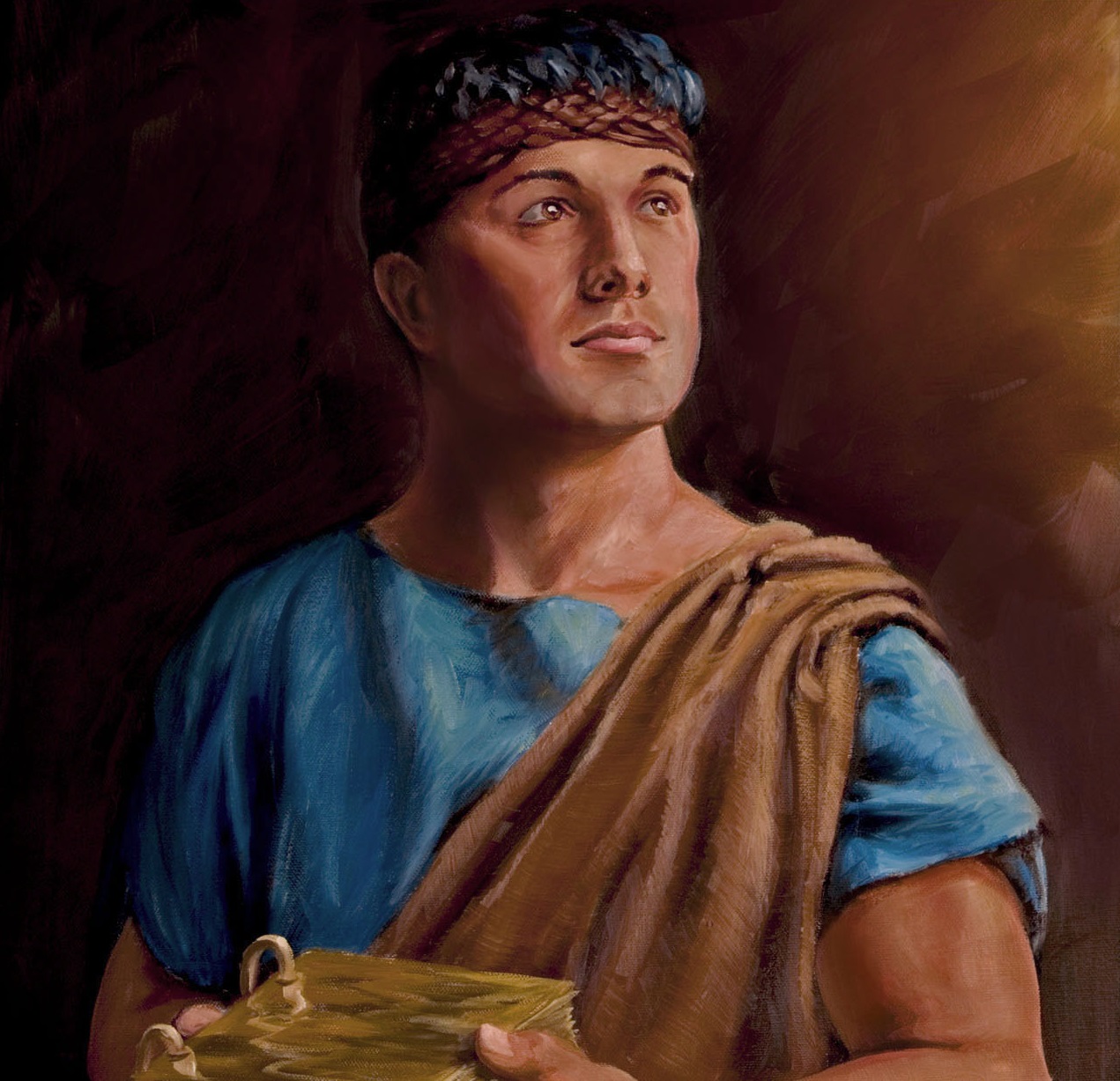
Nephi was the fourth son of Lehi and Sariah, and the brother of Laman, Lemuel, Sam, Jacob, and Joseph. His belief and support of the Lord’s revelations to his father and his determination to be obedient to God often brought him into conflict with his two oldest brothers during their journey to the land of promise. He was the recipient of many visions and revelations of his own. After the death of Lehi, the family divided, and those who were willing to hearken to the commandments of God followed Nephi and became his people. He was both a religious and a political leader. Nephi’s words on the small plates (1 Nephi and 2 Nephi) contain an account of his family’s journey through the wilderness, and some of his visions, prophecies, and teachings.
Total recorded words -- 27,366
Insights into words and phrases

Surprisingly, it is Nephi, rather than Lehi, who first uses the name Jesus
Christ, a name that is revealed to him by an angel (1 Nephi 12:18, original
manuscript; 2 Nephi 25:19). Like his younger brother Jacob, who shares his
appreciation for the writings of Isaiah, Nephi frequently uses the title
"Holy One of Israel" (10 times). Among Book of Mormon speakers, this title
is only used by prophets on the small plates.
In the introduction
to the account of his own visions, Nephi cites a prophecy of his father
concerning the baptism of the "Lamb of God" (1 Nephi 10:10). Nephi’s
questions about his father’s teachings led to a vision of his own, where an
angel showed him the Lamb’s future mission (1 Nephi 11-14). Aside from the
angel himself, Nephi references Christ as the "Lamb" or "Lamb of God" more
than any other speaker in the Book of Mormon text (more than 22 times).
Compare this to Moroni (5 times), Alma (twice), Amulek (once), and Mormon
(once).
The revelations Nephi received figure significantly in
his writings. Nephi uses the adjective great most frequently to refer to
"great things," almost always in reference to things that are revealed or
done by God, as well as what he has personally witnessed.
In
addition to the teachings of his father and his own revelations from God,
Nephi seems to have been greatly influenced by the records on the plates of
brass. He speaks of his delight in the scriptures and in using them to
persuade others to believe in Christ and his mission (2 Nephi 4:15-16;
11:4). He has a particular preference and love for Isaiah’s prophecies,
although the writings of Moses, Zenos, Zenock, and Neum are also
specifically mentioned (1 Nephi 19:10-23).
In contrast to other writers, Nephi has a marked preference for the words
"my father" (99), "beheld" (77), "angel" (45), "my brethren" (62), and
"plates" (52). While Nephi refers to the Lamanites, unlike subsequent
writers, he never uses the term "Nephites" to refer to his own people as
later writers do, but always refers to them as "my people."
Among writers and speakers in the Book of Mormon, he alone uses
the phrases "the seed of my brethren" (12), "representation" (5), "the
records which were engraven upon the plates of brass" (4), "the remnant of
our seed" (4), and "treasury" (4). The phrase "wars and rumors of wars" (4)
is used exclusively by Nephi.
Nephi’s preference for "plainness"
(2 Nephi 31:3) underscores his bold, uncompromising, and forthright style.
His closing words sound a triumphant tone: "I glory in plainness; I glory in
truth; I glory in my Jesus, for he hath redeemed my soul from hell." He
optimistically looks forward to meeting many souls who are spotless before
the judgment-seat of God (2 Nephi 33:6-7). As one writer has observed,
"Nephi’s farewell strikes a dominant chord and is accompanied by timpani
rolls and cymbal clashes," in contrast to his brother Jacob, who "ends
quietly and in a minor key." While both Nephi and Jacob speak boldly, Nephi
seems less concerned with offending the sensibilities of others.
Personal application
Nephi’s words point to key influences in his life---things revealed to him
by God, sacred scriptures, and his family. When you read Nephi’s words,
consider ways that you can have a greater appreciation for the Lord's
revelations. Consider how the gift of the Holy Ghost and the scriptures as a
way to receive daily revelation that will bless your life in greater
measure, like Nephi and his family.
Hearkening to the Word
Laman and Lemuel complained that they had suffered in the wilderness
"because we would hearken unto his [Father Lehi’s]
words." They also asserted that the people of the land of
Jerusalem were a righteous people and that their father had misjudged them
(1 Nephi 17:22).
Nephi uses the theme of the divine word to
teach his brothers the blessings of hearkening to the words of God through
ancient prophets. Their Israelite ancestors would have remained in miserable
bondage had they not "hearkened unto the
words of the Lord," through Moses (1 Nephi 17:23). They were
led through the sea by "his [Moses’] word" (1
Nephi 17:26).
Miracles were accomplished and mortals were
preserved through obedience to the word (1 Nephi 17:29). Rough places were
made smooth, smooth places were broken up, and the earth itself would pass
away through God’s word (1 Nephi 17:46). "According to
his word he did destroy them; and according to
his word he did lead them; and according to
his word he did do all things for them; and there was not any
thing done save it were by his word" (1 Nephi 17:31). Nephi
taught his brothers that the righteous are those who hearken to the word (1
Nephi 17:38). The wicked reject "every word of God" (1 Nephi 17:35) and can
become so insensitive that they "[can]not feel his words" (1 Nephi 17:45).
Nephi uses "word" or "words" 11 times in his response to his brothers.
Personal application
When his brothers complained that they were unhappy because they had hearkened to Lehi’s words in leaving Jerusalem, Nephi reminded them that all blessings come from hearkening to the Lord’s words. The greatest happiness in life comes when we diligently hearken to (in other words, follow) the words of the Lord. As you read Nephi’s words to his brothers, ponder how greater obedience to the Lord’s teachings through the prophets can bring you greater happiness.
Accepting or Rejecting the Word
| Laman and Lemuel | Nephi |
|---|---|
| Our father hath judged them, and hath led us away because we would hearken unto his words; yea, and our brother is like unto him (1 Nephi 17:22). |
Do ye believe that our fathers, who were the children of Israel,
would have been led away out of the hands of the Egyptians if they
had not hearkened unto the words of the Lord?
(1 Nephi 17:23). Now ye know that Moses was commanded of the Lord to do that great work; and ye know that by his word the waters of the Red Sea were divided hither and thither, and they passed through on dry ground (1 Nephi 17:26). Yea, and ye also know that Moses, by his word according to the power of God which was in him, smote the rock, and there came forth water, that the children of Israel might quench their thirst (1 Nephi 17:29). And it came to pass that according to his word he did destroy them; and according to his word he did lead them; and according to his word he did do all things for them; and there was not any thing done save it were by his word (1 Nephi 17:31). Behold, the Lord esteemeth all flesh in one; he that is righteous is favored of God. But behold, this people [the Canaanites] had rejected every word of God, and they were ripe in iniquity; and the fulness of the wrath of God was upon them; and the Lord did curse the land against them, and bless it unto our fathers; yea, he did curse it against them unto their destruction, and he did bless it unto our fathers unto their obtaining power over it (1 Nephi 17:35). Ye are swift to do iniquity but slow to remember the Lord your God. Ye have seen an angel, and he spake unto you; yea, ye have heard his voice from time to time; and he hath spoken unto you in a still small voice, but ye were past feeling, that ye could not feel his words; wherefore, he has spoken unto you like unto the voice of thunder, which did cause the earth to shake as if it were to divide asunder (1 Nephi 17:45). And ye also know that by the power of his almighty word he can cause the earth that it shall pass away; yea, and ye know that by his word he can cause the rough places to be made smooth, and smooth places shall be broken up. O, then, why is it, that ye can be so hard in your hearts? (1 Nephi 17:46). |
Leading Words
Nephi’s brothers complained that their father Lehi was "led away
by the foolish imaginations of his heart; yea, he hath
led us out of the land of Jerusalem" (1 Nephi 17:20). They
also said that their father had "led us away because we would
hearken to his words" (1 Nephi 17:22). In his defense of the Lord and his
father’s prophetic leadership, Nephi uses his brothers’ language to review
their Israelite past.
Nephi notes that the children of Israel
were "led out of bondage," which was a good thing (1 Nephi
17:24-25). They were also led through the wilderness (1 Nephi 17:30),
showing that the Lord "leadeth away the righteous into
precious lands" (1 Nephi 17:38). Nephi uses phrases with the word "led" or
"lead" ("led away out," "lead them out," "led," "leading," "lead them,"
"leadeth away," and "led forth") eight times in his response to his
brothers. He does so to draw an implicit comparison to the experiences of
their own family, who were led by the Lord and the prophet Lehi.
Personal application
Nephi uses his brothers’ own vocabulary to rebut their accusations and to teach them how the past experiences of their ancestors were remarkably like their own, and that the Lord was just as concerned with them as He had been with the children of Israel when they were in the wilderness. As you read Nephi’s words, remember that the Lord cares just as much about you as He did about His people in the past. Try to see yourself as continuing the story of God’s work with His covenant people and think of what you might do to gain a clearer perspective on how you can live in the covenant every day.
Led Away
| Laman and Lemuel | Nephi |
|---|---|
|
And thou art like unto our father, led away by the foolish
imaginations of his heart; yea, he hath led us out of the
land of Jerusalem, and we have wandered in the wilderness for these
many years
(1 Nephi 17:20). Our father hath judged them [the people of Jerusalem], and hath led us away because we would hearken unto his words; yea, and our brother is like unto him (1 Nephi 17:22). |
Yea, do ye suppose that they would have been led out of
bondage, if the Lord had not commanded Moses that he should
lead them out of bondage?
(1 Nephi 17:24). And notwithstanding they being led, the Lord their God, their Redeemer, going before them, leading them by day and giving light unto them by night, and doing all things for them which were expedient for man to receive, they hardened their hearts and blinded their minds, and reviled against Moses and against the true and living God (1 Nephi 17:30). And it came to pass that according to his word he did destroy them; and according to his word he did lead them (1 Nephi 17:31). And he leadeth away the righteous into precious lands, and the wicked he destroyeth, and curseth the land unto them for their sakes (1 Nephi 17:38). And they did harden their hearts from time to time, and they did revile against Moses, and also against God; nevertheless, ye know that they were led forth by his matchless power into the land of promise (1 Nephi 17:42). And now, after all these things, the time has come that they have become wicked ... I know that the day must surely come that they must be destroyed, save a few only, who shall be led away into captivity (1 Nephi 17:43). |
Nephi’s Defense in 1 Nephi 17
When Nephi began to build a ship, as commanded by the Lord, his brothers
Laman and Lemuel claimed that Nephi lacked the ability to perform such a
task (1 Nephi 17:17). They then launched into a complaint over their
perceived wrongs, for which they held Nephi and his father responsible (1
Nephi 17:19-22). Nephi’s lengthy response is interesting because he draws
upon several words and ideas expressed in that complaint to teach, testify,
and defend the prophetic calling of his father Lehi (1 Nephi 17: 23-51).
Several examples of this can be seen in Nephi’s use of the words, "ye know,"
"led" or "lead," and his teachings relating to the need to "hearken" to the
"word" or "words" of God (See Ye Know, Leading Words, and
Hearkening to the Word in this directory).
Personal application
Nephi shows how God teaches His word and blesses His children through His appointed prophets. His words also show how great teachers can build faith by reminding others of what they already know, or knew but may have forgotten.
Ye Know
Laman and Lemuel use the words "we knew" when they assert Nephi’s lack of
abilities (1 Nephi 17:19). They also use to the words "we know" when they
assert that the people of Jerusalem were a righteous people, wrongly judged
by their father (1 Nephi 17:22). Nephi responds to his brothers by reminding
them what they know. "Ye know that the children of Israel were
in bondage; and ye know that they were laden with tasks, which
were grievous to be borne; wherefore, ye know that it must
needs be a good thing for them, that they should be brought out of bondage"
(1 Nephi 17:25). He also reminds them of Moses� divine call, which was much
like their father’s. "Ye know that Moses was commanded of the Lord" (1 Nephi 17:26). He also uses the words "ye know" to remind
them of the miracles God performed through Moses (1 Nephi 17:26-29, 42).
Nephi uses the phrases "ye know" and
"ye also know" eleven times in his defense.
When
speaking of his own knowledge, Nephi says, "I know not but they [the people
at Jerusalem] are at this day about to be destroyed," but then testifies
that "I know that the day must surely come that they must be
destroyed" (1 Nephi 17:43). Unlike his brothers, who say they know things
that are really false, Nephi testifies only to what he does actually know.
By reminding his brothers of the past experiences of their ancestors,
something no Israelite would deny, Nephi is able to draw a parallel with
their own family experiences in the wilderness and defend their father’s
prophetic leadership.
Personal application
Nephi used the very words spoken by his brothers to remind them of what they already knew about their past, to encourage them to be more faithful. When you read Nephi’s words responding to the criticisms of his brothers, ponder what you can do to remember the great things the Lord has done for you in the past, to encourage you to be more obedient in the future.
Knowing and Not Knowing
| Laman and Lemuel | Nephi |
|---|---|
|
We knew that ye could not construct a ship, for
we knew that ye were lacking in judgment; wherefore, thou
canst not accomplish so great a work
(1 Nephi 17:19). And we know that the people who were in the land of Jerusalem were a righteous people; for they kept the statutes and judgments of the Lord, and all his commandments, according to the law of Moses; wherefore, we know that they are a righteous people; and our father hath judged them, and hath led us away because we would hearken unto his words; yea, and our brother is like unto him (1 Nephi 17:22). |
Now ye know that the children of Israel were in bondage; and
ye know that they were laden with tasks, which were grievous
to be borne; wherefore, ye know that it must needs be a good thing
for them, that they should be brought out of bondage.
Now ye know that Moses was commanded of the Lord to do that great work; and ye know that by his word the waters of the Red Sea were divided hither and thither, and they passed through on dry ground. But ye know that the Egyptians were drowned in the Red Sea, who were the armies of Pharaoh. And ye also know that they were fed with manna in the wilderness. Yea, and ye also know that Moses, by his word according to the power of God which was in him, smote the rock, and there came forth water, that the children of Israel might quench their thirst (1 Nephi 17:25-29). And they did harden their hearts from time to time, and they did revile against Moses, and also against God; nevertheless, ye knowthat they were led forth by his matchless power into the land of promise. And now, after all these things, the time has come that they have become wicked, yea, nearly unto ripeness; and I know not but they are at this day about to be destroyed; for I know that the day must surely come that they must be destroyed, save a few only, who shall be led away into captivity (1 Nephi 17:42-43). And ye also know that by the power of his almighty word he can cause the earth that it shall pass away; yea, and ye know that by his word he can cause the rough places to be made smooth, and smooth places shall be broken up. O, then, why is it, that ye can be so hard in your hearts? (1 Nephi 17:46). |


