
Brief biography
circa 120 B.C.
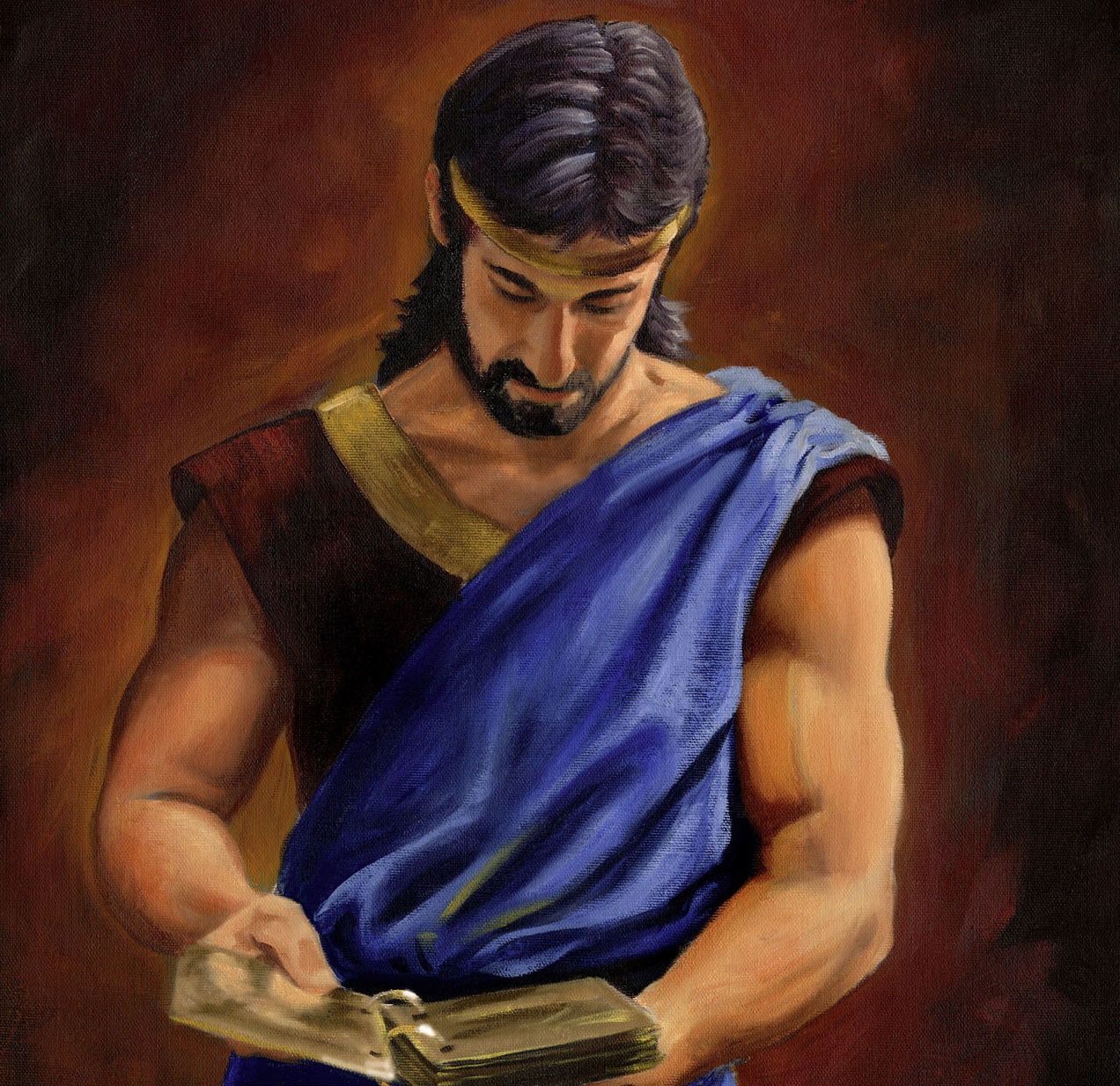
Mosiah was the son of King Benjamin and the last Nephite king in the land of Zarahemla. He became king at the age of 30 (Mosiah 6:4). He presided over the deliverance and reunification of Limhi’s people and the people of Alma with his own (Mosiah 7:1-2; 22:13-14; 24:25). He also supported the establishment of the Church, under Alma’s leadership, throughout the land (Mosiah 25:19; 26:8-12). Mosiah possessed the gift of seership, which he used to translate the 24 gold plates discovered by Limhi’s people, which gave an account of the Jaredites (Mosiah 28:11-19).
Total recorded words -- 1,179
Insights into words and phrases

Persecution of the Church by unbelievers became a serious issue during
Mosiah’s reign. He established laws to forbid persecution on the basis of
religious beliefs and promote equity among his people (Mosiah 27:1-5). His
four sons with Alma, the son of Alma the High Priest, were once numbered
among the unbelievers who persecuted the Church, but were converted through
the miraculous intervention of an angel (Mosiah 27:8-37).
While
this event was a cause for rejoicing, it created a political challenge when
his sons refused the kingship and devoted their lives to preaching the
gospel among the Lamanites (Mosiah 28:1-10). Under divine direction and with
the voice of the people, Mosiah discontinued the institution of kingship
among the Nephites and established judges (Mosiah 29:1-11).
In
addition to being a king, Mosiah was responsible for establishing a set of
laws to govern the new political system, including a law forbidding slavery
(Alma 1:1; 27:9), as well as a money standard (Alma 11:1). It is notable
that, in spite of the increasing social complexity within his kingdom, there
is no reference to war among the people of Zarahemla during the 23 years of
his reign (Mosiah 29:14). Given the history of the people of Lehi, this
seems a remarkable achievement.
The word "higher" occurs only
four times in the Book of Mormon. Three of these are from Mosiah. Words
about judgment are 38 times more likely to be spoken by Mosiah than in the
rest of the Book of Mormon. Words about laws are nearly 15 times more
likely. The "unrighteous" appears only three times in the Book of Mormon.
One of these three times is used by Mosiah. The words "iniquity,"
"iniquities," or "iniquitous" are 10 times more likely to be used, and it is
50 times more likely that the words "pervert" or "perverting" will be used
by Mosiah than by the other speakers in the rest of the Nephite record. This
is understandable for a king whose life was occupied with the trappings of
government, the judgment of crimes, and punishments (Mosiah 29:15).
Mosiah is the only Book of Mormon speaker to refer to God as the
"all-wise" Creator. He also is the only one to use the words "arrange,"
"enacteth," "extending," "iniquitous," "interposition," "newly,"
"posterity," "remains," "sees," and "trampleth."
Mosiah’s words,
although they are few, suggest that he drew upon several sources. His
concerns over the danger that his son Aaron might change his mind, desire
the kingship, and "draw away" a faction of the people, leading to contention
and bloodshed, points to influence from the Jaredite record he had
translated, which recounted the actions of sons of kings who "drew away" or
did "draw away" such factions (Ether 7:4, 15; 9:11; 10:32). Only the book of
Ether shares this language with Mosiah.
Chronologically,
Mosiah’s desire that the land "be a land of liberty" is interesting (Mosiah
29:32)1. That phrase, used in connection with the abolishment of
kingship among the Nephites, reminds the reader of Jacob’s earlier discourse
against kings who rise up against God and Zion, that the land may "be a land
of liberty" (2 Nephi 10:11). Mosiah possessed the small plates of Nephi,
which recorded this teaching of Jacob. These words suggest that as he
pondered the changes in the Nephite political system and the future of his
people, the record and fate of the Jaredites might have been on Mosiah’s
mind and that he might have also been influenced by Jacob’s earlier
teachings.
Personal application
Mosiah spoke of the "trials and troubles of a righteous king, yea, all the
travails of soul for their people, and also all the murmurings of the people
to their king" (Mosiah 29:33). Mosiah, who spoke from personal experience,
used words that reflected the task of one who often had to make such
decisions. He also seems to have been one who drew upon divine guidance to
make difficult decisions, including the scriptures. We may not be kings, but
we can also draw upon divine guidance as we face different challenges in our
lives.
1 Lehi had also previously used the phrase "land of liberty," but
not in connection with kingship (2 Nephi 1:7).


