
Brief biography
circa A.D. 400
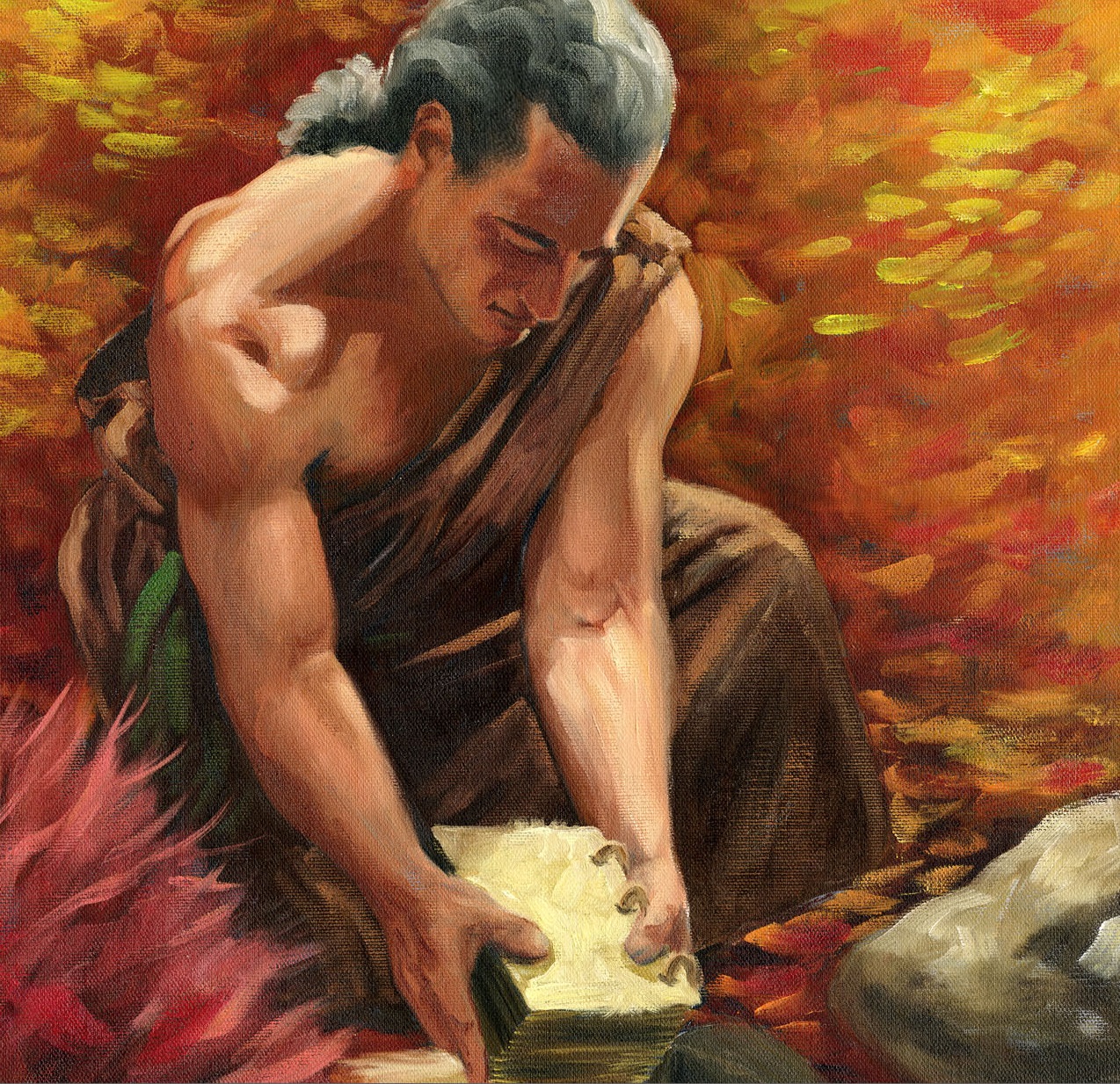
Moroni was the son of Mormon, the last Nephite record keeper in the Book of Mormon, and a missionary (Moroni 8:1-2). During the battle at Cumorah, he led a cohort of 10,000 and he was one of only twenty-four Nephites who survived the battle (Mormon 6:11-12). After the death of his father Mormon, he wandered for more than thirty-five years until he was able to finish, seal up, and bury the plates in the hill in New York. Moroni’s words include biographical and prophetic material written after his father’s death (Mormon 7-9), his abridgement and commentary on the record of Ether (Ether 1-15), instructions on Church government (Moroni 1-6), and his farewell words to future readers (Moroni 10).
Total recorded words -- 19,563
Insights into words and phrases

Moroni is the only speaker among the top eight in the Book of Mormon whose use of the words "Christ" and "faith" are both in his top-50 contextual words and statistically significant. Moroni only mentions the Lamanites at a rate of about one-fourth the rate of the rest of the Book of Mormon. Words unique to Moroni include "Hebrew" (3), "imagined" (3), and "imperfection" (3). Other words that only occur in his abridgement of Ether’s record include 26 proper names not mentioned anywhere else in the Book of Mormon, "dwelt in captivity" (7), "tight like unto a dish" (5), and "slept" (4).
Moroni’s words include some of his own revelations from God, but one of his significant characteristics as a writer is his tendency to pepper his words with those of earlier writers. As one scholar observes, "His first inclination is to use the words of his predecessors," and he does so "by interweaving distinctive phrases and structural schemes from multiple thematically related sources."1 He is familiar with Isaiah (Mormon 8:23; Moroni 10:31). He also includes teachings from his father, including a sermon on faith, hope, and charity (Moroni 7), a letter condemning the baptism of little children by members of the Church of Christ (Moroni 8), and a letter describing the wickedness of the Nephites in their final days (Moroni 9). It is clear that Moroni’s father’s teachings had a tremendous influence on him.
In addition to the small plates, which were included with the abridgment (Words of Mormon 1:1-8), Moroni also knows of and cites teachings of the resurrected Jesus that were not included in the account in 3 Nephi (Mormon 9:22-25; Ether 12:32-33, 35; 10:23), some of which he may have learned from the three disciples who tarried, who had ministered to him and his father (Mormon 8:10-11). Moroni uses diverse sources. His words also show a familiarity with the small plates of Nephi (See The Influence of the Plates of Nephi.).
Personal application
Moroni’s familiarity with the teachings of earlier Nephite prophets is consistent with a writer who was the last record keeper of the Nephites. He saw himself as the last in a long line of prophets with the responsibility to testify of Christ and the gospel, as taught by the Lord to his people. "Behold, I speak unto you as if ye were present, and yet ye are not. But behold, Jesus Christ hath shown you unto me, and I know your doing" (Mormon 8:35). As we read Moroni’s words, it may be helpful to put ourselves in his shoes as we ponder what he wrote, and ask why, among so many other teachings, he felt these would be the most important for us in our day.
1 Grant Hardy, Understanding the Book of Mormon: A Reader’s Guide (New York: Oxford University Press, 2010), 266. Hardy notes, "By employing the words of others, Moroni shifts the notion of authorship and makes himself the self-effacing inheritor, or spokesman, for an entire literary tradition. He is able to appeal to the authority of past prophets and record keepers (at the same time reinforcing the respect due them), and he can reward close readers who are able to recognize phrases and make connections. His allusions and quotations are a call to remembrance and a recognition of how dependent he is on the faithfulness of those who preceded him" (Hardy, 267).
Moroni and Jehovah
Moroni, alone among Nephite record keepers, uses the word "Jehovah," and he
only does so in the concluding line of the Book of Mormon (Moroni 10:34).
The only other place in the Book of Mormon where the name Jehovah appears is
where Nephi is citing Isaiah from the plates of brass in 2 Nephi 22:2
(Isaiah 12:2). If, as in the Old Testament, that name represents a literal
translation of the Hebrew Tetragrammaton (the sacred and protected name of
God), or its equivalent in the language of the Nephites, this may be
significant. 1
Personal application
Moroni, after promising that we would see him before the bar of God at the
day of judgment, and inviting us to come unto Christ, the Holy One of
Israel, evokes the name Jehovah, just as he concludes the record. He
essentially seals the record with the sacred name of God, thereby placing
the Lord’s stamp of approval upon all that is written there.
As
you read the Book of Mormon and ponder its precepts, remember that you are
reading a sacred record. Think of ways that you can hold yourself
accountable to God for the prophetic teachings it contains.
1 John W. Welch, "Ten Testimonies of Jesus Christ from the Book
of Mormon," in Bruce Van Orden and Brent L. Top, eds.,
Doctrines of the Restoration: The 1991 Sperry Symposium (Salt Lake
City: Deseret Book, 1992), 238-39.
The Influence of the Plates of Nephi
Moroni’s words show a significant influence from the small plates of Nephi,
as he sometimes quotes from or paraphrases from that record. Such phrases
include, "the blood of saints shall cry" (Mormon 8:27; 2 Nephi 26:3;
28:9-10), and his reference to a scripture that says "God is the same
yesterday, today, and forever" (Mormon 9:9; Moroni 10:19; 1 Nephi 10:18).
His description of the final judgment seems to draw upon the
language of Jacob, when he uses the phrases, "And then cometh the judgment,"
that the "filthy shall be filthy still" and the "righteous shall be
righteous still" (Mormon 9:14; 2 Nephi 9:15-16). Moroni, however, adds the
meaningful words, "he that is happy shall be happy still; and he that is
unhappy shall be unhappy still" (Mormon 9:14).
Moroni’s critique
of those who ignore the poor and needy might have been influenced by Nephi’s
teaching. Both speak of "pride," neglect of the "poor," and a materialistic
focus on "fine" things, including clothing and church adornment, which
infect all "save a few" (Mormon 8:36-37; "save it be a few," 2 Nephi
28:11-14). His reference to those who justify sin (Mormon 8:31) may also
echo Nephi’s words on the same theme.
Moroni writes that the
time will come that "Satan may have no power upon the hearts of the children
of men" (Ether 8:26), which nearly matches Nephi’s prophecy, "Satan shall
have power over the hearts of the children of men no more, for a long time"
(2 Nephi 30:18; 1 Nephi 22:15, 26). They also share a scripture that says
the first shall be last and the last shall be first (Ether 13:12; 1 Nephi
13:42; Jacob 5:63).
In his final farewell, Moroni says his words
help to fulfill earlier prophecies that they shall "proceed forth out of the
mouth of the everlasting God" and that "his word shall hiss forth" (Moroni
10:28). The prophecy seems to refer to the Lord’s words spoken to Nephi that
"the words of your seed should proceed out of my mouth unto your seed; and
my words shall hiss forth unto the ends of the earth" (2 Nephi 29:2;
25:21-22).
It is especially interesting that Moroni evokes words
and images from Jacob’s and Nephi’s farewells when he speaks of meeting
readers at the "bar" of God, "as one speaking out of the dust" (Moroni
10:27-28; "as one crying from the dust" (2 Nephi 33:11, 13). Like Jacob,
Moroni wants to "meet you before the pleasing bar" of God (Moroni 10:34;
Jacob 6:13).
Personal application
Moroni’s words show that he was familiar with and pondered the teachings of earlier prophets, whose writings were inscribed on the small plates that his father Mormon had included in the Book of Mormon. His words show a clear affinity with the earlier words of Nephi. As you read Moroni’s words, ponder how a familiarity with the teachings of the prophets can enlighten your perspectives and help you to find joy and peace in times of loneliness and difficulty, as they did for Moroni.
Nephi and Moroni
| Plates of Nephi | Moroni |
|---|---|
|
And there are also secret combinations, even as in times of
old, according to the combinations of the devil, for he is the
founder of all these things; yea, the founder of murder, and
works of darkness
(2 Nephi 26:22). And the blood of the saints shall cry from the ground against them (2 Nephi 28:10). |
And it shall come in a day when the blood of saints shall cry unto the Lord, because of secret combinations and the works of darkness (Mormon 8:27). |
| For he is the same yesterday, today, and forever (1 Nephi 10:18). |
For do we not read that God
is the same yesterday, today, and forever?
(Mormon 9:9). He is the same yesterday, today, and forever (Moroni 10:19). |
| They who are righteous shall be righteous still, and they who are filthy shall be filthy still (2 Nephi 9:16). | He that is filthy shall be filthy still; and he that is righteous shall be righteous still; he that is happy shall be happy still; and he that is unhappy shall be unhappy still (Mormon 9:14). |
| Because of pride . . . they have all gone astray save it be a few, who are the humble followers of Christ (2 Nephi 28:14). | There are none save a few only who do not lift themselves up in the pride of their hearts (Mormon 8:36). |
|
And because of the righteousness of his people,
Satan has . . . no power over the hearts of the people
(1 Nephi 22:26). Satan shall have power over the hearts of the children of men no more, for a long time (2 Nephi 30:18). |
I . . . write these things . . . that Satan may have no power upon the hearts of the children of men (Ether 8:26). |
| And the last shall be first, and the first shall be last (1 Nephi 13:42. See also Jacob 5:63). | And when these things come, bringeth to pass the scripture which saith, there are they who were first, who shall be last; and there are they who were last, who shall be first (Ether 13:12). |
|
And you and I shall stand face to face before his bar (2
Nephi 33:11). I speak unto you as the voice of one crying from the dust (2 Nephi 33:13). |
For ye shall see me at the bar of God; and the Lord God will say unto you: Did I not declare my words unto you, which were written by this man, like as one crying from the dead, yea, even as one speaking out of the dust (Moroni 10:27). |


