
Brief biography
circa 74 B.C.
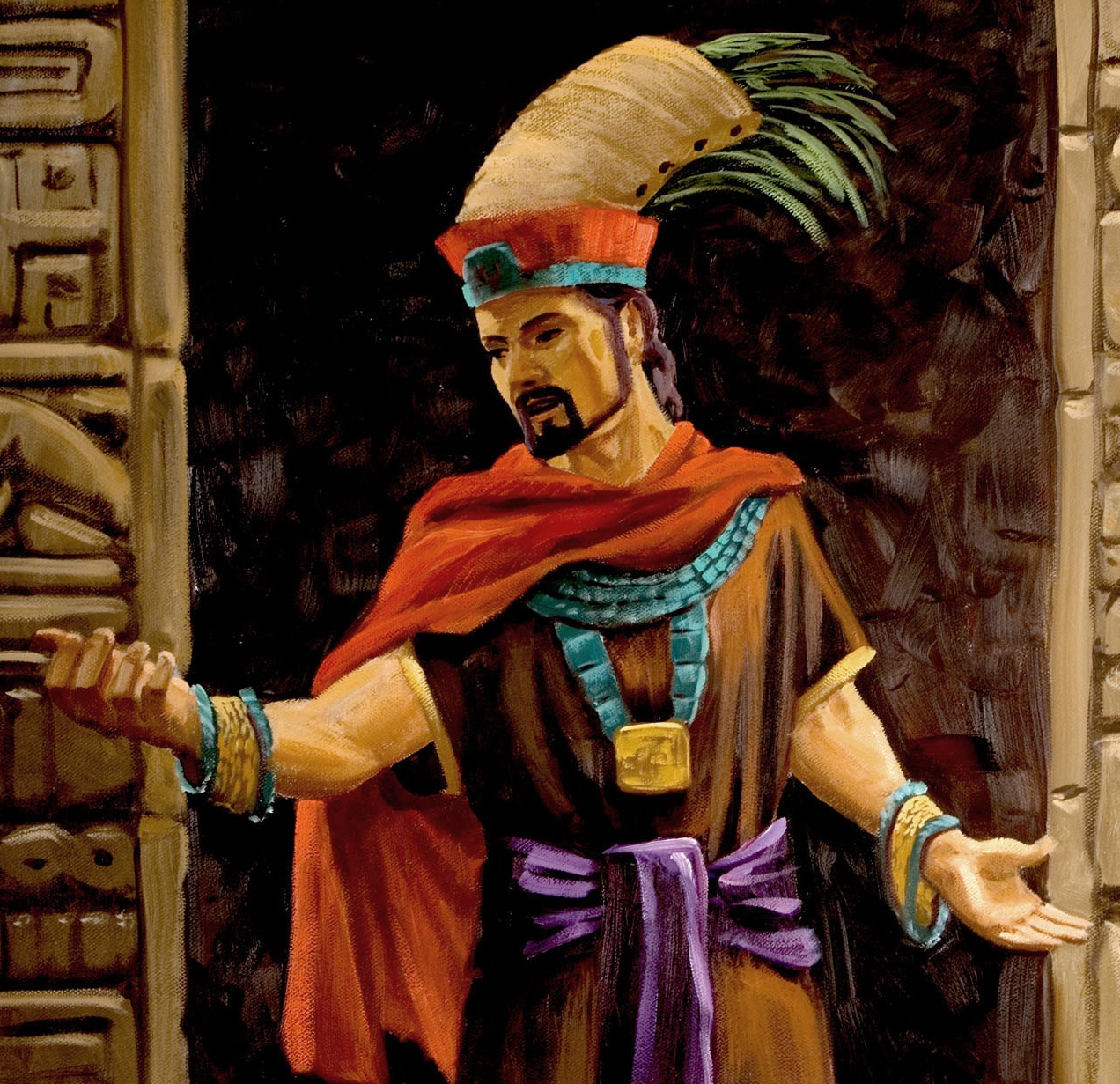
Korihor was a false but influential teacher, during the reign of Chief Judge Nephihah, who preached against the Church and the doctrine of Christ. He declared that there was no God and claimed that a man prospered only according to his abilities, that "whatever a man did was no crime" (Alma 30:17), and that "when a man was dead, that was the end thereof" (Alma 30:18). According to Korihor, there was no such thing as sin, and therefore, no need for an atonement. He claimed that beliefs, actions, and ordinances based upon the teachings of Christ were foolishness. Joy from repentance, spiritual gifts, and personal revelation, he claimed, were fantasies based upon a deranged mind (Alma 30:13-16). He was brought before Alma, questioned, and demanded a sign from God. As the sign, he was struck dumb. Unable to speak, he was forced to beg for food. When he went among the Zoramites, he was trampled to death.
Insights into words and phrases

Korihor is the only Book of Mormon speaker to use the words "whims,"
"derangement," "frenzied," "foolish," "foolish traditions," "ordinances and
performances," "unknown being," and "pretended mysteries." His application
of the word "pretended" to Nephite spiritual gifts is noteworthy. His words
reinforce his false materialistic message, which asserts that one can only
know what one can experience with the natural senses.
In Korihor’s view, God is an "unknown being" because people cannot see him.
Nephite mysteries are "pretended" for the same reason. Korihor’s words
reveal the tactics of the devil, who taught him what to say. His words are
crafted to make those who believe and obey Gospel ordinances appear foolish.
He uses the unique phrase, "the foolish traditions of your fathers," three
times.
Korihor deceived his listeners by appealing to their
carnal nature and by making obedience to divine commandments seem difficult.
He turned Nephite teachings about redemption from the bondage of sin and the
liberty of the Gospel on their heads by characterizing the belief in Christ,
and the need to prepare for life after this, as a form of bondage that kept
individuals from doing what they wanted. His teachings appeal to the natural
man.
Freedom, according to Korihor, was living without
constraints. "Ye say that this people is a free people. Behold, I say they
are in bondage" (Alma 30:24). He characterized those who followed the
teachings of Christ using the terms "bound down," they "bind themselves
down," are "brought down," under a "yoke," and are in "bondage." He asserted
that Nephite religious leaders wanted to "keep them down" in a state of
subservience. He claimed that religious leaders wanted to "glut" themselves
on the labors and fruits of others, based on things that could not be seen
or experienced by those they exploited.
Personal application
Korihor’s clever, but empty, words were inspired by the devil. His messages were designed to flatter the unwary and lead people lead away from Christ. His words in the Book of Mormon can help us to detect similar falsehoods and deceptions today.
Korihor and Deception by Partial Truth
Korihor’s deceptive strategy included presenting only a part of the truth
and then attacking it. We can see this in how he disparaged the doctrine of
the Fall of Man. "Ye say that this people is a guilty and a fallen people,
because of the transgression of a parent. Behold, I say that a child is not
guilty because of its parents" (Alma 30:25). This kind of argument would
appeal to the unwary because it makes the doctrine of the Fall seem unfair.
But it was deceptive.
Nephite doctrine taught that Christ atoned
for Adam’s transgression and that little children have eternal life through
the Redeemer (Mosiah 15:25). Nephite doctrine also taught that individuals
were responsible for their own sins and transgressions; however, Korihor’s
incomplete characterization tainted the doctrine with an appearance of
unfairness to lead people away.
Personal application
Korihor’s practice of misrepresentation by only presenting a partial truth was effective at deceiving many in Alma’s day, but he was eventually confounded and abandoned by the devil and those who once supported him. The account of Korihor shows us how the adversary tries to deceive by presenting only an incomplete version of the truth. As you read about Korihor’s false teachings, consider how they reveal the strategies in the devil’s playbook. An awareness of those evil tactics can help you to be wise, and detect and avoid deception today.
Chronology
All dates are approximate.
74 B.C. Korihor preaches among the people of Nephi and leads many people astray. He is rejected in the lands of Jershon and Gideon, and carried before Nephihah and Alma in Zarahemla. He rails against God, demands a sign, and is smitten dumb. He begs for food among the Zoramites and is trampled to death.


