
Brief biography
Circa A. D. 34
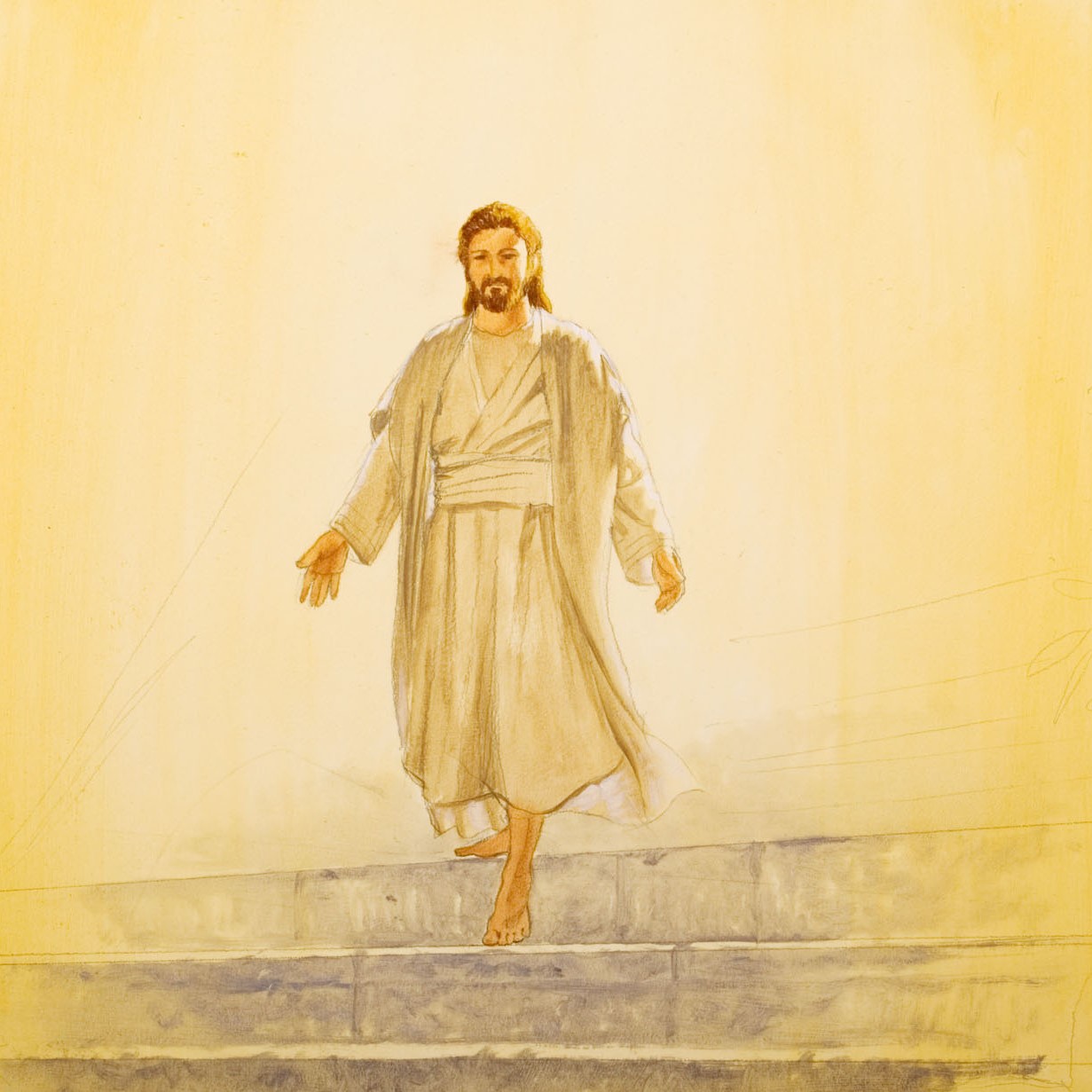
For the people of Nephi in the land of promise, the Savior’s manifestation to them, after His death and His appearance in glory following His resurrection from the dead, was a transformative event. At the beginning of the thirty-fourth year after the sign of Jesus’ birth had been given, there was great destruction among the wicked, followed by three days of darkness. It was during this time of darkness that Jesus Christ announced the scope of the destruction that had occurred, identified Himself as the Creator and Redeemer, and invited those who had not been destroyed to repent and receive Him (3 Nephi 9:1-22; 10:3-7). Later, at the end of that same year, while the people were gathered at a temple in the land of Bountiful, Jesus descended from heaven and taught the people for a period of three days (3 Nephi 11-26). He continued to visit them from time to time thereafter during this time of righteousness (3 Nephi 26-28). Many of the words He spoke to the people during this visitation were recorded, including those that Mormon was permitted to inscribe in the Book of Mormon (3 Nephi 26:6-11).
Total recorded words -- 9,820
Insights into words and phrases

Only two speakers in the Book of Mormon refer to "Heavenly Father;" Jesus
does so three of these four times. Jesus’ favorite noun is "Father," which
He uses 149 times. This is appropriate, given Jesus’ teaching that He and
the Father are one in testimony, doctrine, and will. It also points to the
closeness of His relationship with Heavenly Father.
His favorite
verb is "be," which He uses over 200 times in the text. The resurrected
Jesus’ favorite adverb is "verily." He uses the phrase, "Verily, I say," 21
times and for emphasis, He doubles it, saying "Verily, verily, I say," 23
times. The word "verily," used so often by the Savior, underscores the truth
of His words. He is the only speaker in the text who uses the phrases "build
upon my Gospel," "my flesh and blood," "this is my doctrine," "upon my
rock," and "come unto me and be baptized in my name."
Personal application
Jesus’ use of the verb "be" is notable because it constitutes a command to all those who desire to follow Him. It is both a command and an invitation to follow Him in the way of righteousness and happiness in order to become even as He is ("even as I am," 3 Nephi 27:27). The Savior’s laser-like focus on what we can be through Him and His love and redeeming power, not on what we have been, constitutes the very essence of our hope as disciples of Jesus Christ. It invites us to look to the future, not dwell on the failures of the past. Consider how you can exercise faith in Jesus Christ by looking to the future.
Mormon and Additional Teachings of Jesus
And now it came to pass that when Jesus had expounded all the scriptures in one, which they had written, he commanded them that they should teach the things which he had expounded unto them (3 Nephi 23:14).
In another passage, Mormon writes:
And now it came to pass that when Jesus had told these things
he expounded them unto the multitude; and
he did expound all things unto them, both great and small.
And he saith: These scriptures, which ye had not with you,
the Father commanded that I should give unto you; for it was wisdom in him
that they should be given unto future generations.
And he did expound all things, even from the beginning until the time
that he should come in his glory---yea, even all things which should come upon the face of the earth,
even until the elements should melt with fervent heat, and the earth
should be wrapt together as a scroll, and the heavens and the earth should
pass away;
And even unto the great and last day, when all
people, and all kindreds, and all nations and tongues shall stand before
God, to be judged of their works, whether they be good or whether they be
evil---
If they be good, to the resurrection of everlasting
life; and if they be evil, to the resurrection of damnation; being on a
parallel, the one on the one hand and the other on the other hand,
according to the mercy, and the justice, and the holiness which is in
Christ, who was before the world began
(3 Nephi 26:1-5).
Mormon mentions that Jesus provided a detailed exposition and teachings about these things, but does not quote or provide details about what Jesus actually said. He just gives a very general outline of the subject matter. He then explains,
And now
there cannot be written in this book even a hundredth part of the
things which Jesus did truly teach unto the people;
But behold the plates of Nephi do contain the more part of the
things which he taught the people.
And
these things have I written, which are
a lesser part of the things which he taught the people; and I have
written them to the intent that they may be brought again unto this
people, from the Gentiles, according to the words which Jesus hath spoken.
And when they shall have received this, which is
expedient that they should have first, to try their faith, and if it shall
so be that they shall believe these things then shall the greater things
be made manifest unto them.
And if it so be that they will not
believe these things, then shall the greater things be withheld
from them, unto their condemnation.
Behold,
I was about to write them, all which were engraven upon the plates of
Nephi, but the Lord forbade it,
saying: I will try the faith of my people.
Therefore,
I, Mormon, do write the things which have been commanded me of the
Lord
(3 Nephi 26:6-12).
So, when Mormon was recording the words of Jesus in his abridgment of the Nephite records in 3 Nephi, he was commanded by the Lord to only include a small part of the available teachings of Jesus. When he discusses the future ministry of the three Nephite disciples, he does not go into detail, but mentions that there are other teachings of Jesus that discuss what they will do.
And behold they will be among the Gentiles, and the Gentiles shall know
them not.
They will also be among the Jews, and the Jews shall
know them not.
And it shall come to pass, when the Lord seeth
fit in his wisdom that they shall minister unto all the scattered tribes
of Israel, and unto all nations, kindreds, tongues and people, and shall
bring out of them unto Jesus many souls, that their desire may be
fulfilled, and also because of the convincing power of God which is in
them.
And they are as the angels of God, and if they shall
pray unto the Father in the name of Jesus they can show themselves unto
whatsoever man it seemeth them good.
Therefore, great and
marvelous works shall be wrought by them, before the great and coming day
when all people must surely stand before the judgment-seat of Christ;
Yea even among the Gentiles shall there be a great and
marvelous work wrought by them, before that judgment day.
And if ye had all the scriptures which give an account of all the
marvelous works of Christ, ye would, according to the words of Christ,
know that these things must surely come.
(3 Nephi 28:27-33).
Here, Mormon alludes to other words of Christ, which provide details on these things, but he obediently discusses them only in general terms.
In another passage, Mormon writes:
Yea, and wo unto him that shall say at that day, to get gain, that there can be no miracle wrought by Jesus Christ; for he that doeth this shall become like unto the son of perdition, for whom there was no mercy, according to the word of Christ! (3 Nephi 29:7).
We do not have the words of Christ that speak about the son of perdition receiving no mercy, but apparently the Nephites had a record of them. Mormon mentions them, but does not quote them.
Nevertheless, and notwithstanding all these miracles, the people did harden their hearts, and did seek to kill them, even as the Jews at Jerusalem sought to kill Jesus, according to his word (4 Nephi 1:31).
We have no record in our current Book of Mormon of Jesus describing the efforts of the Jews to kill him during his mortal ministry. Apparently, the Nephites did; but Mormon does not quote them.
Mormon quotes the words of Jesus in his commentary on Nephite apostasy in the book of Helaman, before he gets to 3 Nephi.
Yea, who shall be consigned to a state of endless misery, fulfilling the words which say: They that have done good shall have everlasting life, and they that have done evil shall have everlasting damnation. And thus it is. Amen (Helaman 12:26).
These words, which are similar to words found in the Gospel of John 5:29, are not found in the teachings of Jesus in 3 Nephi. Assuming these were words spoken by the resurrected Jesus to the Nephites, this would be the only example where Mormon actually quotes words from Jesus resurrected ministry to the Nephites that are not found in that account. Usually, he only mentions a teaching of Jesus in passing, without actually providing a quotation.
After Mormon’s death, Moroni includes a sermon from his father on the plates. This document was not included in Mormon’s abridgment, but includes several quotations from the Savior’s resurrected ministry to the Nephites not found elsewhere in the Book of Mormon.
And after that he came men also were saved by faith in his name; and by
faith, they become the sons of God. And as surely as Christ liveth
he spake these words unto our fathers, saying: Whatsoever thing ye
shall ask the Father in my name, which is good, in faith believing that ye
shall receive, behold, it shall be done unto you
(Moroni 7:26).
And Christ hath said: If ye will have faith in me ye shall have
power to do whatsoever thing is expedient in me
(Moroni 7:33).
And he hath said: Repent all ye ends of the earth, and come unto
me, and be baptized in my name, and have faith in me, that ye may be saved
(Moroni 7:34).
The last passage is similar to, but not the same as, that in 3 Nephi 27:20, which does not include the words "and have faith in me, that ye may be saved," suggesting that this was from another source. These additional quotations do not come from Mormon’s abridgment, but fortuitously from Moroni’s inclusion of his father’s sermon.
Personal application
Mormon informs the latter-day reader that he only gave us a small part of
the teachings of Jesus available to him in his abridgment. His repeated
references to additional teachings in only a general way is consistent with
his explanation that he does so by divine commandment. In spite of his
personal inclination to include everything the resurrected Jesus taught his
ancestors, he was submissive and obedient to the Lord’s counsel.
Significantly, we do receive some of these
additional teachings in the portion of the Book of Mormon prepared by
Mormon’s son, Moroni, who includes a sermon that was not part of his
father’s abridgment. The inclusion of these few additional words of Jesus,
indirectly through Moroni’s selection, constitutes one of the tender mercies
of the Lord, for which we can be thankful.
Moroni and Additional Teachings of Jesus
For behold,
thus said Jesus Christ, the Son of God, unto his disciples who should
tarry, yea, and also to all his disciples, in the hearing of the
multitude:
Go ye into all the world, and preach the gospel to every creature;
And he that believeth and is baptized shall be saved, but he
that believeth not shall be damned;
And these signs shall
follow them that believe’in my name shall they cast out devils; they shall
speak with new tongues; they shall take up serpents; and if they drink any
deadly thing it shall not hurt them; they shall lay hands on the sick and
they shall recover;
And whosoever shall believe in my name,
doubting nothing, unto him will I confirm all my words, even unto the ends
of the earth
(Mormon 9:22-25).
This passage partially resembles words found in Mark 16:15-18, a passage that some biblical scholars have argued was not original to the text of Mark. What is interesting here is that Moroni solemnly affirms that Jesus spoke these words to the three Nephite disciples and the Nephite Twelve, and the multitude heard it also. Numerous witnesses could testify that Jesus gave these words to the Nephites.
This is an example in which the Book of Mormon supports the teachings of Jesus we have received through the Bible. It suggests that, whatever the textual history of Mark, these were authentic words of the Savior that somehow were either lost from earlier biblical manuscripts or were given orally by the Savior and not recorded, but which are true.1
Moroni also draws upon teachings of the resurrected Jesus in his abridgment of the book of Ether.
And the Lord commanded the brother of Jared to go down out of the mount
from the presence of the Lord, and write the things which he had seen; and
they were forbidden to come unto the children of men until after that he
should be lifted up upon the cross; and for this cause did king Mosiah
keep them, that they should not come unto the world until after Christ
should show himself unto his people.
And after Christ truly had showed himself unto his people he commanded
that they should be made manifest
(Ether 4:1-2).
We do not have the account Moroni speaks of in 3 Nephi, but it was included in Jesus teachings to the Nephites that Moroni knows about.
And I also remember that thou hast said that thou hast prepared a house for man, yea, even among the mansions of thy Father, in which man might have a more excellent hope; wherefore man must hope, or he cannot receive an inheritance in the place which thou hast prepared (Ether 12:32).
This passage is interesting because it reminds us of John 14:2, although it reads differently and includes additional teachings. This suggests that Moroni is citing a passage from teachings not included by Mormon in 3 Nephi, but which may have been similar to those taught by Jesus to the Apostles.
Wherefore, I know by this thing which thou hast said, that if the Gentiles have not charity, because of our weakness, that thou wilt prove them, and take away their talent, yea, even that which they have received, and give unto them who shall have more abundantly (Ether 12:35).
This passage again reminds us of similar teachings from Jesus in the New Testament, in the parable of the talents (Matthew 25:14-30). This suggests that the Nephites may have possessed a similar parable (or its equivalent in Nephite terms, since "talent" was a word peculiar to the Roman World), which Moroni drew upon in his commentary and applied to the Gentiles.
And again, I remember that thou hast said that thou hast loved the world, even unto the laying down of thy life for the world, that thou mightest take it again to prepare a place for the children of men (Ether 12:33).
While this concept is found in other Book of Mormon passages, the difference in phrasing indicates that Moroni drew upon additional words of Jesus.
And Christ truly said unto our fathers:If ye have faith ye can do all things which are expedient unto me (Moroni 10:23).
This statement attributed to Jesus is similar to Mormon’s quotation in Moroni 7:33, but is not exactly the same. This suggests that it might have been from a different source, or perhaps the statements in Moroni 7:33 and 10:23 represent these prophets paraphrasing of Jesus words, rather than an exact record.
Personal application
Moroni’s paraphrases of Jesus’ words in the book of Ether point to
additional teachings of the resurrected Savior that were part of the Nephite
archive. They also suggest that at least one parable may have been part of
the larger corpus of material from the resurrected Savior to his Saints in
the New World. This increases our appreciation for Moroni’s additional
inclusions of these precious teachings from the Savior.
Moroni’s
citation of a Mark-like passage provides an additional testimony to the Book
of Mormon reader that Mark’s teachings are genuine, although
biblical-manuscript evidence for similar teachings in Mark’s Gospel may be
weak or potentially problematic.
Mormon, in his final testimony,
wrote concerning the Book of Mormon and the Bible: "For behold, this is
written for the intent that ye may believe that; and if ye believe that ye
will believe this also" (Mormon 7:9). This constitutes a significant example
of how the words of Jesus in the Book of Mormon confirm the words of Jesus
found in the Bible, and how they both work together to increase our faith in
the gospel of Jesus Christ. Examine your own testimony of the New Testament.
Consider how it can be strengthened through the witness of the Book of
Mormon.
1 For a discussion of the issue of the ending of Mark 16, see
Julie M. Smith, The Gospel According to Mark (Provo, Utah: BYU
Studies, 2018), 827-835.
Ye Must Bow Down
Shortly before his death, the prophet Nephi, the son of Lehi, taught his people to believe in and worship Jesus Christ. He explained that "the right way is to believe in Christ, and deny him not; and Christ is the Holy One of Israel; wherefore ye must bow down before him, and worship him with all your might, mind, and strength, and your whole soul; and if ye do this ye shall in nowise be cast out" (2 Nephi 25:29). He then prophesied that Jesus would appear to His people after His resurrection from the dead, and they should prepare themselves to receive and obey the teachings He would give them at that time (2 Nephi 26:1).
When the resurrected Jesus descended from heaven and appeared to the people,
He introduced himself as the Lord Jesus Christ. Mormon recorded that the
people on this occasion remembered that it had been prophesied that He would
visit them, and fell to the earth. Jesus then invited those present to arise
and come forth to feel the prints of the nails in His hands and feet and the
wound in His side, which they did (3 Nephi 11:14-15). "And when they had all
gone forth and had witnessed for themselves, they did cry out with one
accord, saying: Hosanna! Blessed be the name of the Most High God! And they
did fall down at the feet of Jesus, and did
worship him" (3 Nephi 11:16-17). Jesus then invited Nephi to
come forth. "And Nephi arose and went forth, and bowed himself before the
Lord and did kiss his feet" (3 Nephi 11:19).
The words
"worship," "bowed," and "before" draw the reader’s attention to Nephi’s
commandment to his people hundreds of years before. The multitude "did
fall down at the feet of Jesus and did
worship him." As the spiritual leader of the Nephites, and the
namesake of his righteous ancestor, the later Nephi "bowed
himself before the Lord," just as the other Nephi said he should do. In doing so,
Nephi sets the pattern for all the Nephites as
to what they should do.
Personal application
The practice of bowing down before the Holy One of Israel highlights the sacredness of the event in 3 Nephi. Bowing down no doubt helped to focus the attention of the people, placing them in a state of readiness to receive His teachings. These actions also suggest that they were physically offering their entire might, mind, strength, and whole soul before the Holy One of Israel, in willingness and readiness to obey, which is the essence of true worship (2 Nephi 25:29; Omni 1:26; Moroni 10:32). Ponder how your own actions, including your pattern of worship, can better reflect your willingness and readiness to serve the Lord.
| Nephi | The Nephites |
|---|---|
| And now behold, I say unto you that the right way is to believe in Christ, and deny him not; and Christ is the Holy One of Israel; wherefore ye must bow down before him, and worship him with all your might, mind, and strength, and your whole soul; and if ye do this ye shall in nowise be cast out (2 Nephi 25:29). |
And it came to pass that when Jesus had spoken these words the whole
multitude fell to the earth; for they remembered that it
had been prophesied among them that Christ should show himself unto
them after his ascension into heaven (3 Nephi 11:12). And when they had all gone forth and had witnessed for themselves, they did cry out with one accord, saying: Hosanna! Blessed be the name of the Most High God! And they did fall down at the feet of Jesus, and did worship him (3 Nephi 11:16-17). And Nephi arose and went forth, and bowed himself before the Lord and did kiss his feet (3 Nephi 11:19). |
Chronology
All dates are approximate.
A.D. 34: Jesus is put to death in the land of Jerusalem. In the Lehite land of promise, there is great destruction among the wicked and the land is covered with darkness for three days. During this time, Jesus’ voice is heard and He speaks to the people. At the end of the year, Jesus descends from heaven and shows His resurrected body to the people. He teaches them over a period of three days and continues to minister to them from time to time.


