
Brief biography
Circa 100 B.C.-56 B.C.
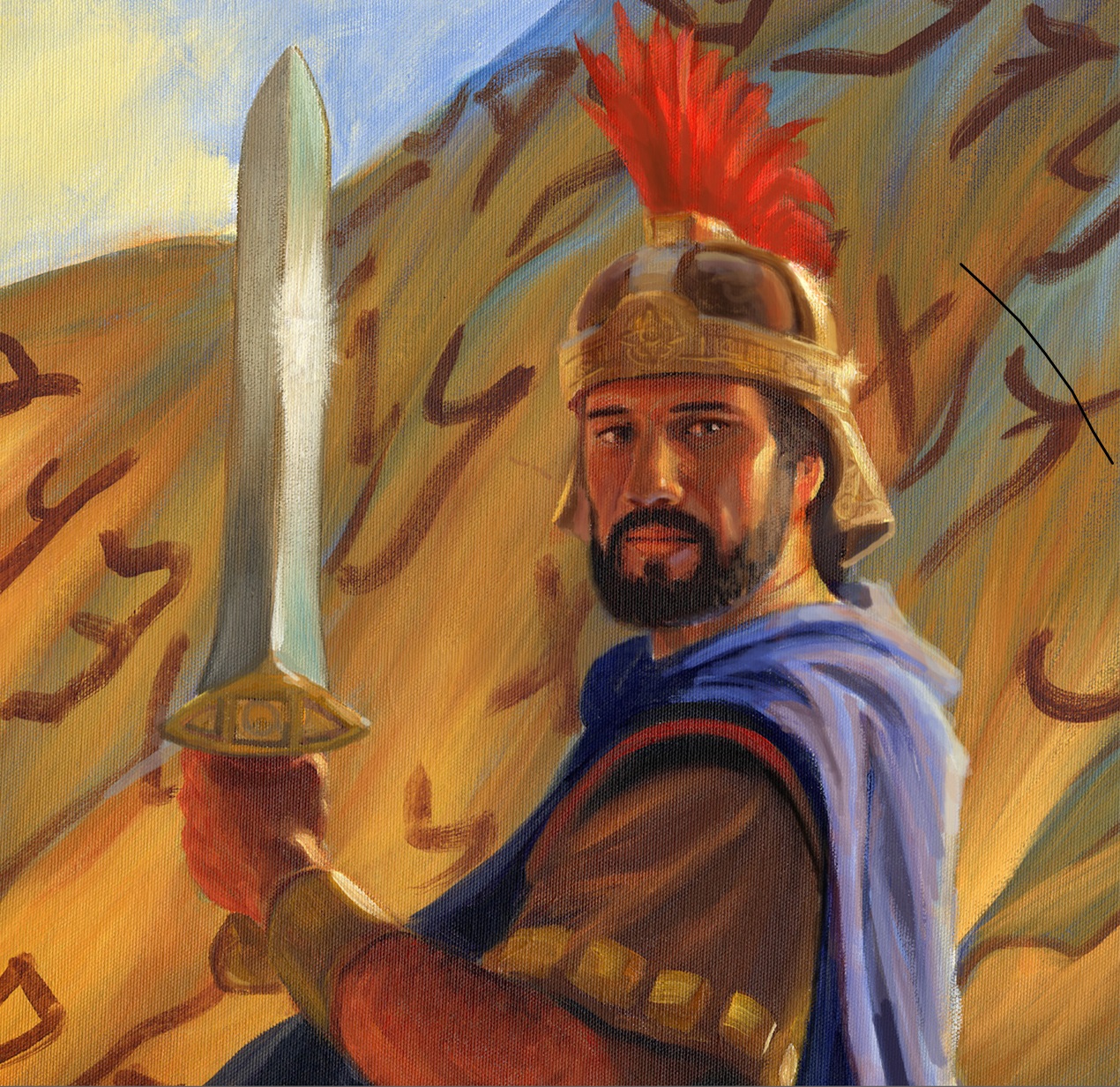
Moroni was chief captain over the Nephite armies during the early reign of the judges. He was appointed chief captain at the age of 25 and served for 17 years (Alma 43:3-4, 16-17; 62:43, 52). The reign of the judges began when he was 7. When he was 12, he would have witnessed the devastating war between the Nephites and the Amlicites and Lamanites, in which tens of thousands of his people were slain, including many women and children (Alma 2:19; 3:1-2; 4:1-3).
Total recorded words -- 3,067
Insights into words and phrases

At the age of 22, he would have witnessed and likely participated in the
devastating war against the Lamanites, following the arrival of the Lamanite
converts in the land of Jershon. The text indicates that this battle was the
most tremendous that had ever occurred among the people of Lehi up until
that time, resulting again in the death of "many thousands" (Alma 28:9-12).
During his time as chief captain, Moroni directed innovations in
defensive armor (Alma 43:18-21; 44:9), fortifications (Alma 48:8; 49:1-25;
50:1-6), and forced relocation and settlement (Alma 50:7-18), designed to
reduce casualties. He also pursued a relatively lenient policy toward
defeated enemy combatants (Alma 44:19-20; 62:16-17) and prisoners, compared
to his enemies. (Compare his actions in Alma 52:38-40; 53:1-5 with those of
Ammoron (Alma 56:12).) One can see these significant innovations being
motivated by a desire to protect his people from the devastation they had
seen in earlier conflicts. One may also wonder if his ascendancy to chief
captain at a young age may have been attributed, not only to his own
abilities, but also due to the great losses of men and leadership in earlier
conflicts.
The text also shows Moroni to be a man of God, as
well as a great military leader (Alma 48:11-18). He knew and cited scripture
(Alma 46:24-26; 60:23). He was faithful to covenants (Alma 44:4, 11;
46:12-23) and he was willing to seek and follow the counsel of prophets like
Alma (Alma 43:23-24) and defend them (Alma 46:1-3, 11). He suffered at least
one serious injury (Alma 52:35) and there are references to his suffering
with his men, "all manner of afflictions of every kind" and "exceedingly
great sufferings," including "hunger, thirst, and fatigue" (Alma 60:3). He
was a much loved, successful, and effective leader, but it is possible that
the physical and psychological demands of his service may have taken their
toll, leading to his death the year after his retirement at the relatively
early age of 43.
As might be expected, Moroni’s language includes words and phrases that echo
his violent occupation. He speaks of the "wounded and bleeding" (Alma
60:22), speaks graphically of those who have "bled out their lives" (Alma
60:9), and tells the incalcitrant Zoramite rebel that he would "spill [his]
blood upon the ground" (Alma 44:11). He warns the impenitent Ammoron of
God’s vengeance, telling of "the sword of his almighty wrath, which
doth hang over you" (Alma 54:6).
Captain Moroni’s use of the
word "religion" is statistically significant. Out of the 10 references to
"religion" in the Book of Mormon, seven come from the Nephite captain. In
fact, in six of those seven, he refers to "our religion." He is the only
Book of Mormon speaker to use that phrase. His use of the word "freedom" is
also significant. Of the 29 times the word "freedom" is used by Book of
Mormon speakers in 264,000 words, it is spoken by Captain Moroni seven times
in only 3067 words. This means he uses "freedom" over 30 times more
frequently than all of the other Book of Mormon speakers. Obviously,
religion and freedom are central to his message. Only Moroni uses the name
"all-powerful God," and he does so specifically in the context of
emphasizing how God had blessed his army to be victorious over a superior
foe (Alma 44:5).
Other words and phrases unique to Moroni
include "be up and doing" (Alma 60:24), "inward," "neglected,"
"slothfulness," "thoughtless," "adhere," "awaits," "bestir," "binds,"
"bleeding," "conflict," "decayed," "hearkening," "impede," "insurrections,"
"manage," "operate," "prisoner," "proposed," "redoubled," "spark," "spill,"
"stated," "stupor," "succored," and "traitors."
Moroni was
conversant with his scriptural heritage. He quotes from a prophecy from the
patriarch Jacob, not found in the Bible, which he applies to his people and
their enemies in a covenant ceremony (Alma 46:24-26). He also makes an
interesting reference to the practice, under the law of Moses, of the
cleansing of vessels (Leviticus 11:32-33; Numbers 19:14-15), indicating that
this was a practice known to Moroni and kept by the Nephites under that law
(Alma 60:23).1
Personal application
Moroni’s example shows that one can be a servant of God, even during the
most difficult of times. His faith in the words of the prophets, his
faithfulness to sacred covenants, and his courage were a great blessing to
his people as he defended their liberties and their religion. As you read
the words of Moroni, ponder how you can develop greater faith and
faithfulness in you own life.
1 "Why Did Moroni Refer to Vessel Impurity in Condemning the
Central Government?" KnoWhy 169 (August 19, 2016).


