
Brief biography
Circa 200 B.C.-121 B.C.
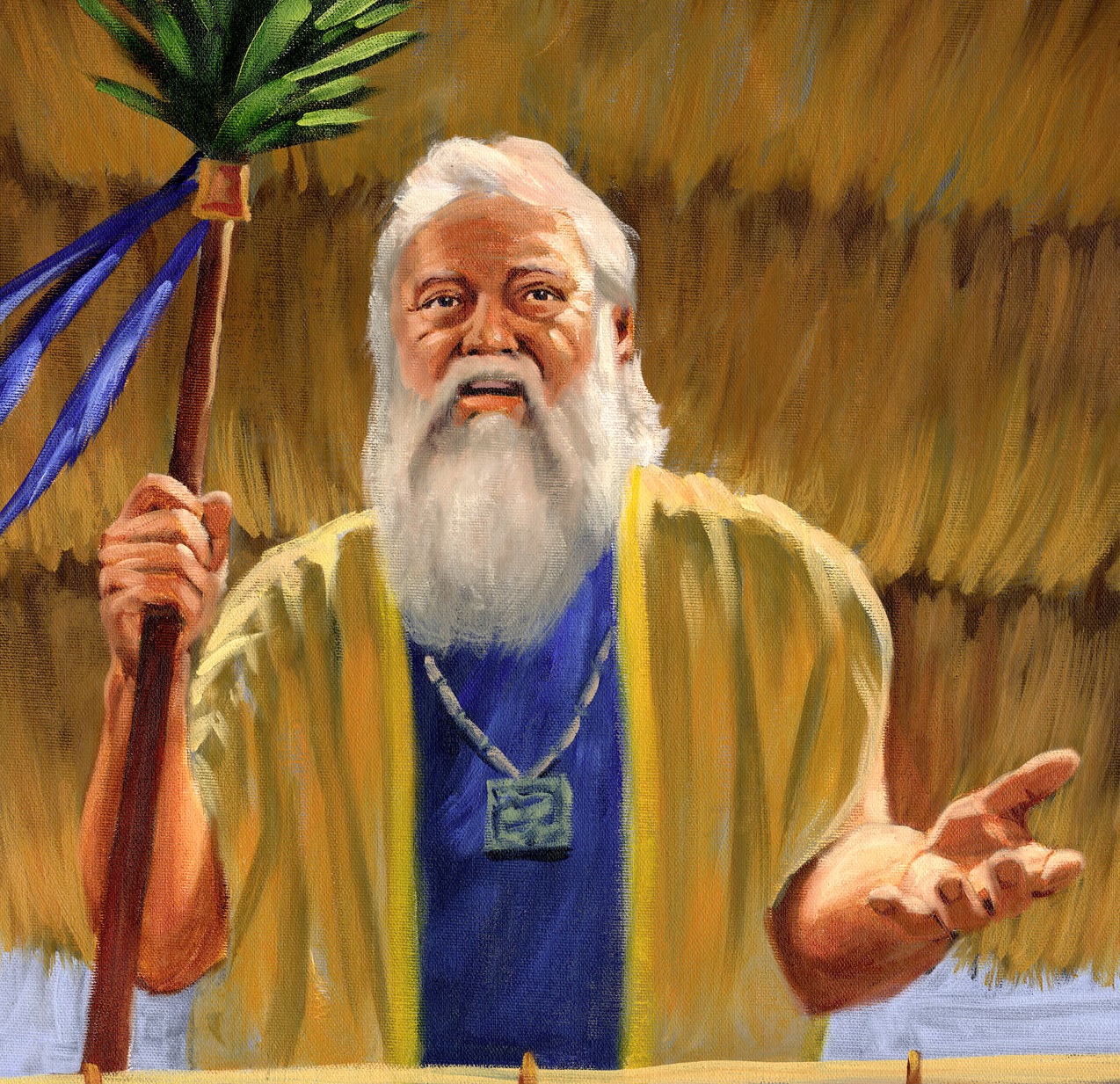
King Benjamin was the son of Mosiah I, a righteous king, and a seer who ruled over the land of Zarahemla. His people included those of different cultural backgrounds: the original inhabitants of Zarahemla and Nephites who had migrated to that region under the leadership of his father. In his earlier years, he had personally fought in defense of his people against the Lamanites and was successful in driving them out of the land.
Total recorded words -- 4,242
Insights into words and phrases

His words are taken from private teachings to his sons (Mosiah 1:3-7), his
son Mosiah (Mosiah 1:10-14), and his final sermon to his people several
years before his death, in which he introduces his son Mosiah as the new
king (Mosiah 2:9-41; 3:1-2; 4:4-30; 5:6-15). Shortly before his sermon,
Benjamin was visited by an angel who testified of Christ, and the king
included the angel’s message in his words to his people (Mosiah 3:2-27).
These words had a remarkable effect upon the people of his day, which was
remembered many years later (Helaman 5:9).
Apart from the angel
(Mosiah 3:5, 17-18, 21), Benjamin is the only Book of Mormon prophet who
uses the word "omnipotent" as an attribute of God (Mosiah 5:2, 15). It makes
sense that, as a king who was becoming acutely aware of his frailty in his
aging years, he would choose to emphasize the incomparable power of God.
Other words used exclusively by Benjamin include "render" (3),
"attention" (1), "adulterous" (1), "attempting" (1), "injure" (1),
"interest" (1), "list" (1), "lively" (1), "peaceably" (1), "prize" (1),
"proclaim" (1), "pronounced" (1), "quarrel" (1), "require" (1), "requires"
(1), "secondly" (1), "stopped" (1), "trifle" (1), "who ever" (1), and
"worthless" (1).
Personal application
After rehearsing the words of the angel of God, who taught of the atoning work of the Lord Omnipotent, Benjamin uses the same term for God that had been used by the messenger. The term omnipotent denotes God’s power to do all things according to His will, including His power to bless His children according to their faith and obedience. As you read the words of King Benjamin, think of ways to exercise greater faith, so that the Lord may more fully bless you.
Avoiding Contention and Deception
King Benjamin’s sermon was given at one of the high points of Nephite
history (Mosiah 1:11). It is easy to forget that this came after an earlier
period of serious difficulty and social conflict. Both Amaleki and Mormon
mention that Benjamin witnessed serious contentions and dissensions among
his people, early in his reign, and it was only through prolonged and
diligent effort that he and other prophets had been able to establish the
peace we find at the time of his farewell address (Omni 1:24-25, 27-28;
Words of Mormon 1:12-18).
Benjamin solemnly warned his people
about future contention and emphasized that such difficulties are inspired
and fomented by "the evil spirit" or the devil (Mosiah 2:32-33; 4:14). No
doubt based upon experiences from earlier in his reign, Benjamin taught by
word and example how humility and gratitude for God’s blessings, which none
of us deserve, keep us humble. Continual prayer and service to others also
increase our happiness and joy (Mosiah 4:11-12).
Happy parents
will not allow their children to engage in contention, but will actively
create opportunities for them to serve each other, which will foster love
and understanding among family members (Mosiah 4:14-15). This will help them
to develop a love of truth and look for opportunities to serve (Mosiah
4:15-16). Benjamin’s act of bestowing upon his people a new name as children
of Christ (Mosiah 5:7-12) reinforced this egalitarian teaching, helping
people of different cultures and backgrounds (the people of Zarahemla and
the Nephites, like people today), to see each other as one people before
God.
Mormon indicates that the problem of "false Christs,"
"false prophets, and false preachers and teachers" (Words of Mormon 1:15-16)
was associated with the contention and dissensions earlier in Benjamin’s
reign. If these false teachers were among those who were seeking to replace
Benjamin as the rightful king, then his focus upon Christ as the heavenly
king in his final sermon can be seen as a way to correct the erroneous ideas
that had contributed to the conflicts of the past. For Benjamin, a proper
king, leader, or teacher is one who is unselfish, who does not seek for
riches or worldly power, but who unselfishly seeks to uplift and strengthen
others and acknowledges, obeys, relies upon, and emulates God, our heavenly
king.
Personal application
Benjamin’s words and example fostered happiness and peace among his people. As you read his teachings, seek to understand how those teachings can help you to establish greater happiness in your family and communities today. Benjamin’s words and teachings can help us avoid the traps of false examples of leadership and emulate the pattern set by Jesus Christ.
King Benjamin and the Poor
A significant focus of King Benjamin’s teachings is our treatment of the
poor. He is the only Book of Mormon speaker to use the words "beggar,"
"beggars," "begged," "supporting," and "dependent." He also is the only one
to use the words "borroweth," "lending," and "indebted." It is the poor and
needy who most often must borrow from others. This concern for the less
fortunate among his people sets Benjamin apart from other leaders who sought
for power and gain.
Benjamin, however, places the rich and the
poor on equal footing by noting that all, even kings, are
beggars indebted to God, an idea that would have seemed surprising to many
of the people of his day. Benjamin emphasized that we are all indebted to
God, a debt that we are never able to repay (Mosiah 2:21-26). Yet, all that
God requires of us is to lend Him our obedience, walk in humility, pray
daily, and give according to our means (Mosiah 2:22; 4:11, 24-27).
Benjamin also corrects the erroneous view that one should only
help those who deserve it, noting that before God, all are unprofitable
servants who receive divine mercy and blessings (Mosiah 4:17-23). This
realization and daily remembrance of our lowly and unprofitable state before
God schools us in how to approach Him with humble reverence and respect. It
helps us to avoid the toxic dangers of pride and selfishness. Benjamin not
only speaks of our responsibility to minister to the poor, but also
emphasizes the blessings that such service brings to our lives, such as
retaining a remission of our sins from day to day (Mosiah 4:12).
As we remember our own unworthiness before God, and remember and
seek to bring physical and spiritual relief to those in need (Mosiah
4:11-12), we will "always rejoice, and be filled with the love of God"
(Mosiah 4:12), "grow in the knowledge and glory" of God (Mosiah 4:12), and
have no desire to injure others (Mosiah 4:13). Only those who serve God as
their Master can really know Him (Mosiah 5:13).
Personal application
King Benjamin’s words and teachings show how ministering to others increases our happiness and our knowledge of the God who loves us, and helps us to become sanctified. As a righteous and humble king, he pointed his people to Christ. When you read Benjamin’s words, try to become more aware of the needs of others and find ways to minister according to your means and ability.
Before Our Eyes
King Benjamin taught his sons how the records on the plates of brass enabled
them to have the Lord’s commandments always "before our eyes," and that if
this had not been the case, "even our fathers would have dwindled in
unbelief" (Mosiah 1:5). He then reaffirmed to them that those records were
true "and we can know of their surety because we have them
before our eyes" (Mosiah 1:6). Only King Benjamin uses this
phrase, and he emphasized to his sons that this was something they were to
"remember" (Mosiah 1:5-6). It is interesting that Benjamin links having the
commandments in the scriptures before our eyes with knowing
that those words are true.
Personal application
Benjamin’s teachings show that the Lord’s commandments light the way for us.
However, where a record of those commandments is missing, future generations
become blind, dwindle in unbelief, and fail in their potential for good.
When the people of Nephi kept the Lord’s words before their eyes, they
remembered God and prospered in their ways. They could thereby know the
truth of his words from day to day, as they were continually reminded of it,
lived it, and loved the truth as the foundation of their peace.
As you ponder on Benjamin’s words, ask yourself how you can
always keep the Lord’s words before your eyes so that the words of
Christ can penetrate your heart and provide daily light as you walk the
covenant path.


