
Brief biography
circa 130 B.C.
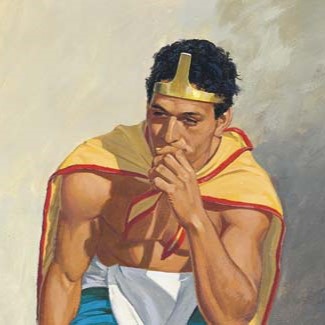
Amaleki was a descendant of Jacob, the brother of Nephi, and the last writer on the small plates. He wrote of the Nephite flight from the land of Nephi under the leadership of King Mosiah I, their re-settlement in the land of Zarahemla, and the unification of the Nephites with the people of that land (Omni 1:12-19). He wrote of Mosiah's translation of a stone inscription giving an account of Coriantumr and his people (Omni 1:20-22), and the early reign of King Benjamin (Omni 1:23-24). He concluded the record with an invitation for us to believe in spiritual gifts and come unto Christ (Omni 1:25-26). Amaleki, who did not have children, entrusted the plates to King Benjamin (Omni 1:25).
Total recorded words -- 921
Insights into words and phrases

The word "ministering" is only used seven times in the Book of Mormon. One
of those times is by Amaleki, even though he only contributes 895 words to
the text. Amaleki is the last Nephite writer to use the title "Holy One of
Israel," a title that is only used by writers on the small plates. Only
Amaleki uses the words "preachings," "severity," and "moons." This last word
refers to the time Coriantumr spent among the people of Zarahemla before he
died. The people of Zarahemla came from Judah, where a lunar calendar was
used.
Amaleki wrote of a significant transitional time in Nephite
history when the Nephites, for unspecified reasons, had to leave the land of
Nephi and resettle in a new location in the midst of a new people. Perhaps
to underscore that such an event was inspired by God, he presents Mosiah’s
actions as similar to those of Nephi, who also led a group of faithful
people from an earlier land of inheritance to a new location.
Mosiah, like Nephi, was warned to "flee" out the land
with all who would "hearken" to prophetic revelation (2 Nephi 5:5-6; Omni
1:12). They fled "into the wilderness" (2 Nephi 5:5; Omni 1:12), where they
each found a new land (2 Nephi 5:7-8; Omni 1:13). Both Nephi and Mosiah
carried records with them, specifically, the "plates of brass" (2 Nephi
5:12; Omni 1:14). Each leader was a teacher in this new setting. Nephi
taught his people building skills (2 Nephi 5:15), while Mosiah taught the
people of Zarahemla the language of the Nephites (Omni 1:18). Each was
appointed a leader in the new setting (2 Nephi 5:15; Omni 1:19).
Amaleki uses the phrase, "the voice of the Lord," at a higher
rate than the rest of the Book of Mormon. The phrase is used in recounting
Mosiah’s leadership of the Nephites out of the land of Nephi and reinforces
the idea that this was done under divine direction.
Some of the
Nephites may not have been happy with Mosiah’s leadership. Benjamin
mentioned contentions during the reign of his father (Mosiah 2:32-33). At
least one significant group departed from Zarahemla and returned to the land
of Nephi; it included Amaleki’s brother (Omni 1:27-30). Amaleki may have
wished to compare Mosiah to Nephi to reinforce the divine legitimacy of
Mosiah’s leadership. His leadership was inspired by God, as was Nephi’s.
Some of Amaleki's words recall things that Nephi wrote.
Nephi mentioned his genealogy, but said he recorded it on his other plates
(1 Nephi 6:1). Amaleki mentions the genealogy of Zarahemla and states that
it was written, "but not on these plates" (Omni 1:18). Nephi mentioned "wars
and contentions" with the Lamanites (2 Nephi 5:34). Amaleki mentions a "war
and serious contentions" among the people of Zarahemla before Mosiah’s
arrival (Omni 1:17). Amaleki’s teaching that we should worship God "with
[our] whole souls" (Omni 1:26) echoes Nephi’s teachings to worship with
"your whole soul" (2 Nephi 25:29). Nephi taught that "Christ is the Holy One
of Israel" (2 Nephi 25:29). Amaleki wrote of "Christ, who is the Holy One of
Israel" (Omni 1:26).
Amaleki seems to have influenced subsequent
Nephite writers, such as Alma, Mormon, and Moroni. The teaching, "there is
nothing which is good save it comes from the Lord: and that which is evil
comes from the devil" (Omni 1:25), seems to have been known and taught by
Alma and Mormon. Alma taught, "For I say unto you that whatsoever is good
cometh from God, and whatsoever is evil cometh from the devil" (Alma 5:40).
According to Mormon, "all things which are good cometh of God; and that
which is evil cometh of the devil" (Moroni 7:12).
Both Amaleki
and Moroni had the unique task of completing a set of plates. Both writers
invite the reader to "come unto Christ," a phrase only used four times in
the Book of Mormon (Omni 1:26; Jacob 1:7; Moroni 10:30, 32). Both mention
the importance of spiritual gifts (Omni 1:25; Moroni 10:8-18).1
Amaleki’s teaching that we should come unto God "and offer our
whole souls as an offering unto him" (Omni 1:26), is interesting in light of
sacrificial practices under the law of Moses. In contrast to other
sacrifices, the burnt offering was one in which the entire animal was
offered and sacrificed upon the altar. The Nephites kept the law of Moses,
and Amaleki seems to draw upon the burnt-offering idea to express how to
properly and sincerely worship God.
Personal application
Amaleki’s words and teachings, even though they are brief, suggest he was a
man who was anxious for others to accept and follow the inspired leadership
of the prophet. He valued the spiritual gifts that he saw manifested in the
life of his king, and faithfully fulfilled his responsibilities as a record
keeper and teacher. We also can follow our prophet’s leadership, seek out
spiritual gifts, and faithfully fulfill our responsibilities.
1 Moroni’s wording resembles that of Paul in the New Testament (1
Corinthians 12:4-11). This might suggest that both Paul and Moroni were
drawing upon teachings of Jesus that we do not have at present (John 21:25;
3 Nephi 26:6-7).


